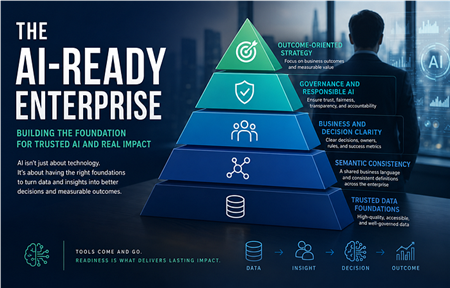
The AI-Ready Enterprise
This article is the first in a series exploring what it truly takes to become an AI-ready enterprise.
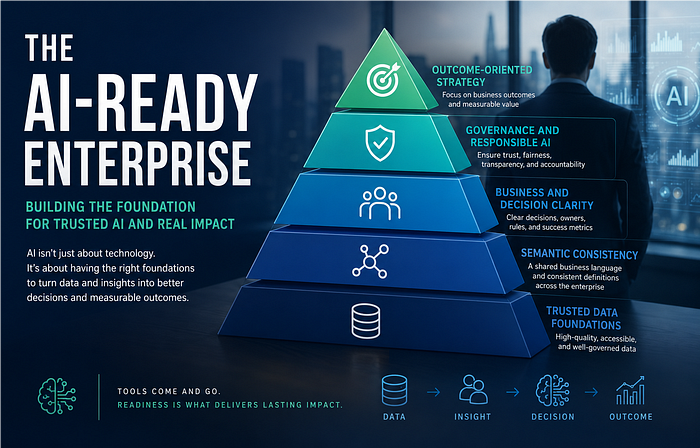
Image co-created with ChatGPT
DISCLAIMER: This image is an AI-generated conceptual illustration created for editorial and educational purposes. It is intended to visually represent the themes discussed in the accompanying blog on AI readiness and enterprise transformation. It does not depict any real organization, system, or proprietary framework.
Why Most Organizations Are Not as Ready for AI as They Think
Most organizations today are actively investing in AI. Copilots are being rolled out, predictive analytics are being piloted, and generative AI tools are appearing across every function from HR and finance to supply chain and customer service. On the surface, it looks like the enterprise is becoming “AI-enabled.”
But there is a growing gap between AI adoption and AI readiness.
An AI-ready enterprise is not defined by how many tools it deploys or how many pilots it runs. It is defined by its ability to consistently turn data, business context, and technology into trusted decisions and measurable outcomes at scale. This is where many organizations are struggling.
AI Tools Are Easy. AI Readiness Is Hard.
It has never been easier to access AI capability. A single API call or SaaS subscription can embed powerful language models or predictive features into business workflows. However, ease of access often hides a deeper problem. Organizations assume that technology equals capability.
In reality, AI amplifies whatever already exists in the enterprise. Strong data foundations lead to strong outcomes. Weak foundations lead to faster, more scalable confusion.
If business definitions are inconsistent, AI will surface conflicting answers. If data quality is poor, AI will confidently reinforce incorrect insights. If governance is weak, AI will create risk at scale.
AI does not fix organizational ambiguity. It accelerates it.
The Five Foundations of an AI-Ready Enterprise
An AI-ready enterprise is built on five critical foundations that extend far beyond technology.
1. Trusted Data Foundations
AI depends entirely on data quality, completeness, and accessibility. Yet many organizations still operate with fragmented systems, inconsistent definitions, and unclear ownership.
When finance defines “revenue” one way and operations defines it another way, AI systems are forced to interpret ambiguity. The result is mistrust in outputs and inconsistent decision-making.
AI readiness begins with disciplined data management including master data, metadata, lineage, and quality controls that ensure the data feeding AI systems is reliable.
2. Semantic Consistency
One of the most overlooked challenges in AI adoption is the lack of a shared business language. Without semantic alignment, AI systems cannot reliably interpret enterprise meaning.
This is where semantic layers, business glossaries, and standardized KPIs become critical. They ensure that when the organization asks “What is our margin?” or “Who is our top customer?”, the answer is consistent across systems.
In many ways, AI readiness is less about algorithms and more about alignment on meaning.
3. Business and Decision Clarity
AI systems do not fail because models are weak. They fail because business decisions are unclear.
AI-ready enterprises ensure that every critical decision has:
- A clearly defined owner
- Agreed inputs and outputs
- Documented business rules
- Measurable outcomes
- Consistent interpretation across teams
Without this clarity, AI systems are forced to interpret ambiguity, which leads to inconsistent recommendations and loss of trust. In many organizations, different teams make the same decision using different assumptions. AI exposes this fragmentation immediately. Business and decision clarity ensures that AI is not guessing what the business means, but executing against well-defined intent.
4. Governance and Responsible AI
As AI becomes more embedded in decision-making, governance becomes non-negotiable. AI introduces risks that traditional systems did not, including hallucinations, bias, privacy concerns, and explainability challenges.
AI-ready enterprises proactively establish governance frameworks that define how AI is used, validated, and monitored. This includes human-in-the-loop validation, auditability, ethical guidelines, and clear ownership of AI-driven decisions.
Trust is becoming the new currency of AI adoption. Without it, even the best models will fail to gain traction.
5. Outcome-Oriented Strategy
Perhaps the most important shift in AI-ready organizations is mindset. Many enterprises start with technology questions such as what AI tools should we adopt or what models should we build.
AI-ready enterprises start with business outcomes. What decisions need improvement? Where are the bottlenecks? What processes can be enhanced? What customer experiences need to be transformed?
This shift ensures that AI is not implemented as experimentation but as value creation.
The Cultural Dimension of AI Readiness
Technology and data are only part of the equation. Culture is often the deciding factor in whether AI succeeds or fails.
Organizations that succeed with AI invest in literacy, not just tools. They help employees understand what AI can and cannot do. They encourage cross-functional collaboration between business, data, and technology teams. They create space for experimentation while maintaining accountability.
Without cultural readiness, even advanced AI platforms remain underutilized or mistrusted.
The Role of Business Analysts in the AI Enterprise
Business analysts sit at a unique intersection in the AI-ready enterprise. They connect business intent with data reality and technological capability. As AI systems become more embedded in decision-making, this role becomes even more critical.
Modern business analysts are evolving into translators of business meaning. They help define what success looks like, ensure that data reflects reality, and validate whether AI outputs align with business expectations.
In many organizations, they are becoming the hidden architects of AI value.
Conclusion: Readiness Is the Real Advantage
The future of enterprise AI will not be defined by who adopts the most tools, but by who builds the strongest foundation for meaningful, trustworthy, and scalable decision-making.
AI-ready enterprises are not built overnight. They emerge through discipline in data, clarity in business meaning, strength in governance, and alignment across functions. Technology will continue to evolve rapidly. Models will become more powerful, interfaces more intuitive, and automation more widespread. But none of this will matter without readiness.
And increasingly, proof of concept is no longer enough.
Many organizations can demonstrate AI in controlled environments, but struggle to scale it into trusted, repeatable, business-critical outcomes. The real challenge is not whether AI can work in a demo, but whether it can work reliably across the enterprise. Because in the end, AI does not transform organizations. People do, when they are ready to use it well.
Is your organization truly building AI capability or simply accumulating AI tools and hoping readiness will follow?
By Sid Arya
Also published on Medium https://medium.com/@sid.arya/the-ai-ready-enterprise-7d646654f99d?postPublishedType=repub